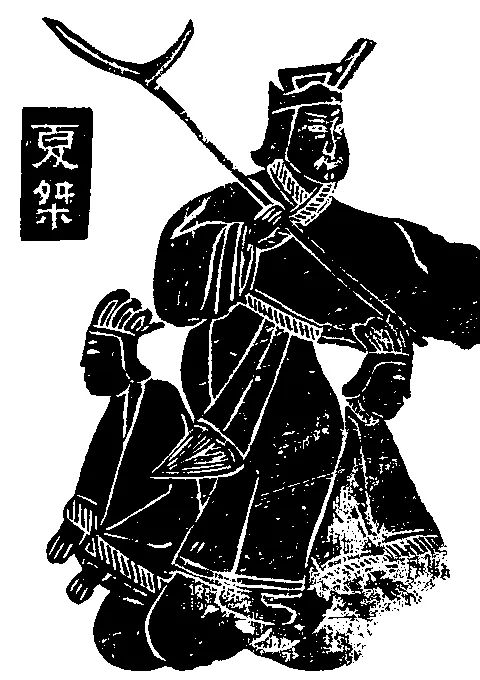
Last king of the Xia dynasty in traditional history, said to have ruled with cruelty and excess until 商汤 overthrew him and founded the Shang. Paired with 纣 in 桀纣, his name stands for any tyrant.
Jie of Xia and Zhou of Shang are the textbook examples of tyrants in Chinese history.
Tips
culture
The idiom 殷鉴不远, 'the mirror for Yin is not far off', comes from a poem in the 诗经: the Shang (殷) kings needed no distant lesson, since Jie's fall lay one dynasty back. It means a warning from recent history.
usage
In modern Chinese the character lives on mainly in 桀骜不驯, 'unruly and untamable', said of a proud, headstrong person; its 骜 is an untamed horse.
Bottom 木 is the wood radical, the original wooden roost-post the feet stood on. It is the indexing radical, though the modern tyrant meaning has nothing to do with trees.
Top is 舛, two feet pointing apart ('to oppose'). Originally the graph pictured a person standing on a wooden post - feet up on a perch above the tree below - giving the early sense 'roost-post,' later borrowed for the king's name.